Skip to content

Save on Retired Taylor Models

In the past year or so, Taylor has been busy revamping their entire line of guitars. They are adding new models with Gold Label Collection, which are inspired by the tone and aesthetics of instruments built in the 1930s but are crafted with modern construction techniques. They are reaching into their past with the Legacy Collection, which give you the sound and vibe of the earliest guitars Bob Taylor and his crew built in the 1970s and 1980s, but with some contemporary tweaks to playability. And they have refined the Standard line with a modified top bracing and a newly designed neck joint. This is all very exciting, but it does mean some models have been retired while some other guitars we have in stock will have the older features. We also have a handful of GS Minis in discontinued colors. We are offering these models at a reduced price and happily, they still come with the full Taylor warranty. 

The Taylor Builder's Editions

The Taylor Builder’s Editions are designed by Andy Powers with a focus on combining comfort and ease of play with maximum responsiveness and tone. Most of the models feature a beveled armrest, chamfered body and fretboard edges, and a reshaped cutaway that flows smoothly into the heel and incorporates a finger bevel where the cutaway meets the soundboard. Other refined touches include “silent” satin finish, which helps quiet the incidental noise against the guitar body.

Taylor's Next Generation Guitars

Taylor has redesigned their standard line of US made guitars from the 300 Series up to the Presentation Series. The Next Generation models have three bigs changes. They now have scalloped V-Class bracing under the hood. The new bracing increases the responsiveness which yields more warmth, power and open-string richness while preserving pitch accuracy that V-Class is known for. 

Secondly, they all have Action Control Necks, which have easier-than-ever string height adjustability. A long-tenon neck joint improves tonal transfer with the body for added warmth and sustain, while the shimless action control feature allows quick, precise string-height adjustments with a simple turn of a bolt through the soundhole.

And third, They are fitted with Taylor’s new Claria pickup, which has been designed with the input from score of players. The Claria pairs an undersaddle piezo pickup with a new proprietary preamp to deliver easy, reliable amplified tone in any live performance setting. Designed for versatility, its clear, natural voice can be shaped from lo-fi warmth to contemporary detail using the soundhole-mounted Volume, Mid-Contour and Tone controls.

The Taylor Legacy Collection

Bob Taylor and his crew were making great sounding and playing guitars 50 years ago, and when those models have enjoyed reasonable care over the years they still play and sound exceptional. The Legacy models offer you a chance to get the sound and vibe of the original Taylors, with some contemporary tweaks than even the most hardened originalist will agree are improvements that Bob would have included back then if he could. Like the guitars built way back when, the new Legacy models have X-Braced tops, white binding and the straight-ear peghead shape that recalls the company’s Lemon Grove days.

The Taylor Gold Label Collection

With the Gold Label Collection, Taylor has designed a series of guitars that are inspired by the tone and aesthetics of instruments built in the 1930s but are crafted with modern construction techniques. The Collection consists of four body styles: the deep-body Grand Concert, the slope-shoulder Grand Pacific, the square-shoulder Dreadnought and the Super Auditorium. 

All of these guitars have torrefied Sitka spruce tops and Taylor’s new Fanned V-Class bracing, a combination that dials up formidable warmth, power and sustain. They all feature the long-tenon Action Control Neck which makes it easy to dial in the perfect feel in minutes.  

Watch Out for Heat Stress!

Excess heat is one of the most unrecognized and destructive forces that act on stringed instruments. I’m talking about the kind of heat that builds up in parked cars. It’s the kind of heat that kills the family dog in short order.

It’s the kind of heat that drives out moisture and causes instruments to crack. It’s the kind of heat that causes glue to melt. It’s the kind of heat that causes necks to warp.

How hot is it?

My car can make it to 175 degrees Fahrenheit in only 15 minutes on a hot day in the sun. At that temperature, it’s not long before the inside of an instrument case gets to be hot, too. At around 140 degrees the glue that holds modern instruments together begins to turn to liquid. LITERALLY.

Let me show you some of the really common heat stress problems that I see regularly.

This Martin D-18 was left in a hot car:

1


The glue lost all its strength and the bridge simply came loose completely. I know that’s what happened because I can see little “strings” of glue underneath, showing that the glue stretched as the bridge was lifted off the face of the guitar. This can ONLY happen in high heat.

Because the strings anchor under the face of the guitar on the bridge plate, the bridge can’t fly off all at once. A classical guitar bridge usually does, because the strings are tied on and don’t go through the face of the guitar.

This guitar was lucky. It’s owner saw the problem right away and loosened the strings before the top suffered more damage.

Here’s a D-28 that wasn’t so lucky. The glue melted in the heat and the bridge came loose and was subsequently reglued by a well-meaning repairman. Apparently no one noticed the severe wrinkles in the top, extending from the corners of the bridge toward the end of the guitar:

2


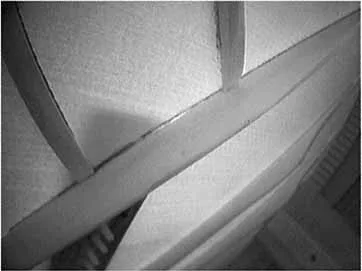
I hope the photo is clear enough. By the way, that’s a round desk lamp and the reflection is distorted by the wrinkled spruce top. When I see a wrinkle this severe in this location, I can tell that the brace has been pulled loose inside the guitar:
3


See that light gap right at the back corner of the bridge shadow? That baby’s really loose! With any luck, I can reglue it and restore much of the strength of the top brace. This is serious stuff, because regluing a brace inside means adding new glue to old glue, and the strength of the bond will be compromised. Usually that’s not a problem the first time. . .When I go to vintage guitar shows, I’m always amazed at how many old guitars I see with this telltale top damage, yet I’ve never seen either a dealer or customer looking inside a guitar to check for problems

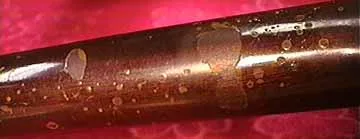
Hey, take a look at this guitar neck:
4
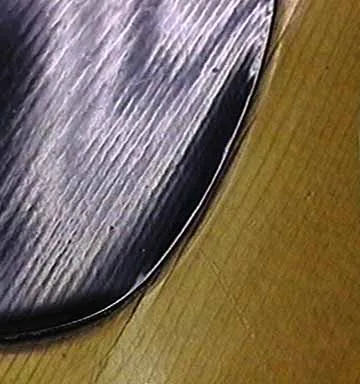
Plastic parts tend to shrink with age as they lose volatile chemical components. In a hot car, this shrinkage can happen much faster:
5


This Martin was repeatedly left in the car at festivals. It never got hot enough to melt glue, but it did get hot enough to accelerate the aging process. Here the pickguard shrank and curled, taking the top with it. Notice the two cracks that are starting to shred the top at the edge of the pickguard.

In addition, the entire instrument was covered with a gummy haze all over the finish. This haze is a result of repeated overheating. In the heat the moisture is driven out of the case lining and interior of the guitar, condensing on the finish as it cools. The gummy residue causes no problem and can be wiped or buffed off, but it is a clear symptom of overheating.

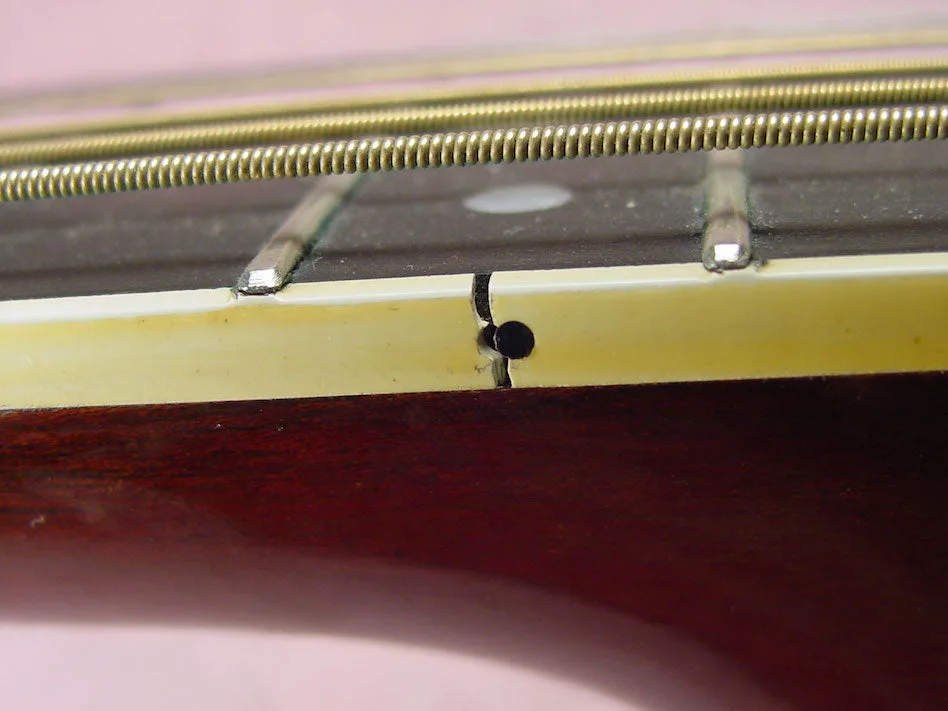
The fingerboard binding on this Martin D-35 shrank prematurely in the heat of a parked car, causing it to crack and separate at its weakest point where the edge dot was inlaid:
73d35heat26

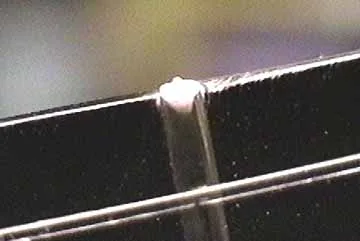
Here’s a fingerboard that shrank in the heat. The moisture was driven out and the wood shrank enough that the fret ends stick out like little spears:
6


These guys are sharp enough to cut your hand. Not just annoying, they too are a symptom of overheating. Once the wood shrinks, no amount of rehumidifying will cause it to regain its full original size. The sharp fret ends are easily repaired by filing level with the fingerboard.

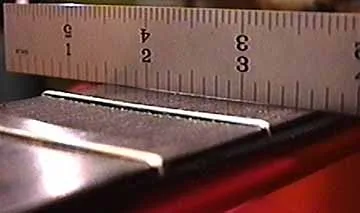
What’s not easily repaired is the other damage caused when the fingerboard shrank:
7


This is the same classical guitar fingerboard. It was originally flat, but is now cupped and concave through its entire length. Unfortunately, because of the heat the frets are also slightly loose as well. The only way to make this guitar play really well is to take out all the frets, level the fingerboard and install new frets. A big job that would not have been necessary otherwise.


And, just to show how bad it can get  here’s one of the most dramatic ones we’ve seen.  It’s a Martin D-45, and it was left in a parked car in the sun during at least one hot summer day.   The wood shrank as a result of catastrophic drying, and it cracked alongside the fingerboard where the wood had been cut for the original abalone inlay.  The heat was great enough to soften the glue that held the interior braces, allowing the string tension to pull the neck forward, displacing the soundhole inlay as well:

d45fbtopcrack02


Please watch out for parked cars. Your car won’t get hot while you’re driving, so when you stop, just think of your instrument as being a living thing inside the car. If the heat would kill your dog, it could also kill your guitar. The same thing goes for other sources of high heat: direct sunlight, heaters, fires, etc.

Now, if you’re travelling, you may have your sleeping bag with you. You can protect your instruments in the car trunk by covering them with LOTS of insulation. After all, if your sleeping bag will keep you warm, it will also keep your guitar cool. Insulated and reflective case covers help, too. Only, don’t count on them for long term protection. Better to avoid heat altogether.


Token Flatpicks Now In Stock!

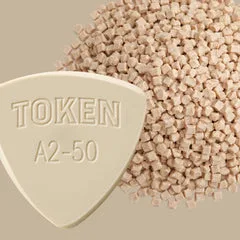
Long favored by advanced bluegrass flatpickers seeking maximum efficiency, a proper speed bevel is key to maximizing glide for players of any genre. With carefully designed edge geometries, these picks move effortlessly across the strings in both directions. Only Token uses a proprietary, computer-controlled milling process to cut these critical shapes into every pick with the consistency advanced playing demands, and with benefits for all levels of playing.

What Are They Made from?

Amber “No. 1” is a translucent US-made virgin polyetherimide long used in the pick industry for balanced tone, solid attack, low friction, and pro-level durability. Its ductile properties provide a soft feel while still delivering a bright, articulate, tone.

Tan “No. 2” is a virgin US-made polyetheretherketone with excellent mechanical properties. It maintains strength and stiffness, resists wear, and has a low-friction surface. It delivers a warm, balanced tone with a smooth, buttery feel. 

Green “No. 3” is a Token Made™ exclusive, made with a proprietary process from a unique formulation of US-made polyamide-imide. It delivers exceptional durability, surprising volume, velvet glide, and Goldilocks tone for a whole new flatpicking experience.

Beard Deco Phonic Guitars

Paul Beard is no newcomer to resonator guitars, as major players like Jerry Douglas, Mike Auldridge, and other A-list players have used Beard Dobros. But except for the imported versions bearing his trademark, Beard resonator guitars have always been, well, kinda pricey. That has changed thanks to Paul’s Deco Phonic line, as he has taken the Collings Waterloo concept and applied it to resonator guitars made right in his Maryland workshop. These Deco Phonic models are made by the same small crew (nine or ten guys), and feature simple but classy designs, thin low-gloss finishes, and offer great tone and playability at very affordable prices.

The name “Deco Phonic” is more than just a cute-sounding title. The whole resonator guitar phenomena began during the Art Deco era, and if you look at an original National Tri-Cone or the coverplate from a later Dobro, the influence of Art Deco design is hard to miss. Paul Beard’s Deco Phonic models are inspired by the Regal-made Dobros of the mid-1930s, instruments that provided guitarists with additional volume and sustain in the days before magnetic pickups made it easy to plug-in and get loud. Gryphon just got a new shipment of Beard Deco Phonic models, and we’re happy to be offering both roundneck and squareneck models. Most feature the Beard Legend cone and #14 cast spider bridge, a combination that delivers authentic dobro tone and plenty of volume.

Creek Guitars

Earlier this year, a crew of builders from the Japanese company Creek Guitars stopped by with four of their guitars, and we were so impressed with their works that we got all of them. The folks at Creek describe their instruments as Brand New Vintage Guitars, and we think they have done an exemplary job of living up to their motto. They are focusing on the slope-shoulder acoustics and semi-hollow body electrics that were built in Kalamazoo, Michigan in the late 1950s and they have really captured the look, tone and feel of the era.

The quartet we got are part of Creek’s Time Machine Series and they all feature lightly aged finishes. The acoustics have torrefied Adirondack spruce tops, mahogany back and sides and Madagascar rosewood bridges and fretboards. The electrics also have Madagascar fretboard and with laminated maple back and sides. In a nice touch, they wind their own humbucking pickups. Please stop by and give them a try. We think you’ll agree Creek Guitar are something special.

The Martin D-45S 1936 Project 91-3 Limited Edition Guitar

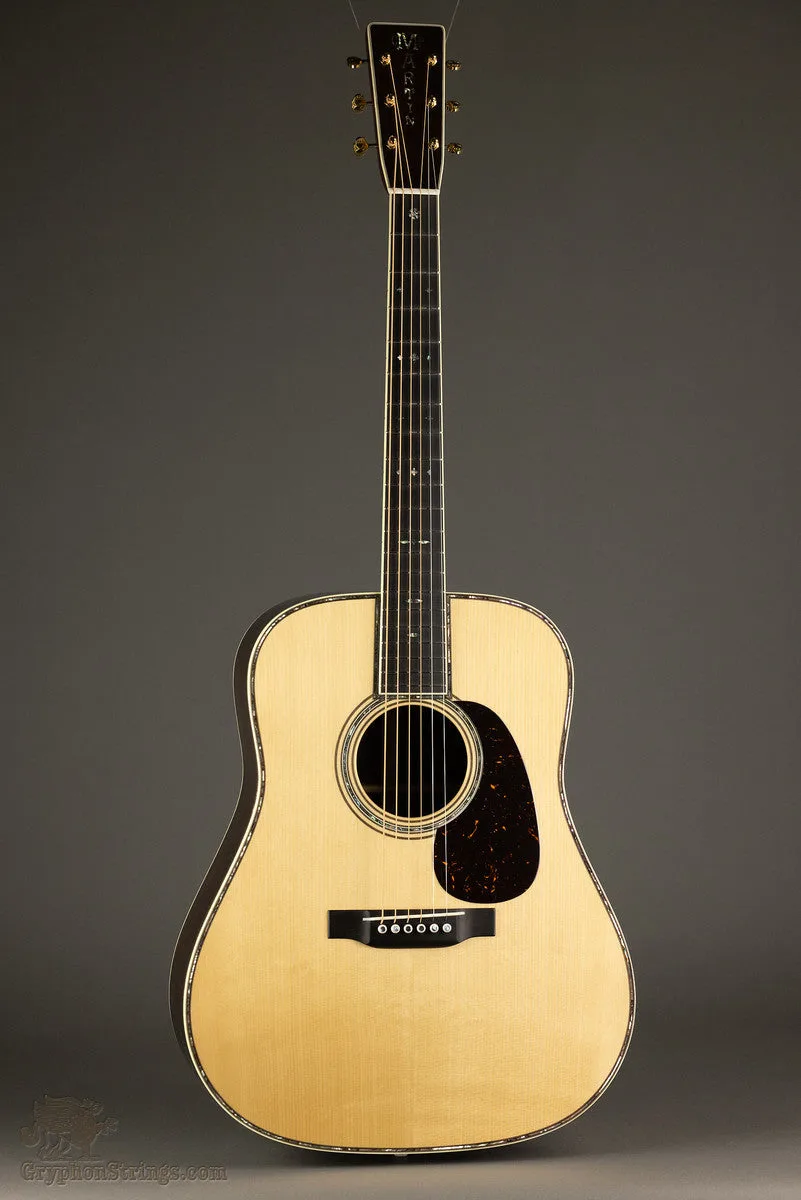
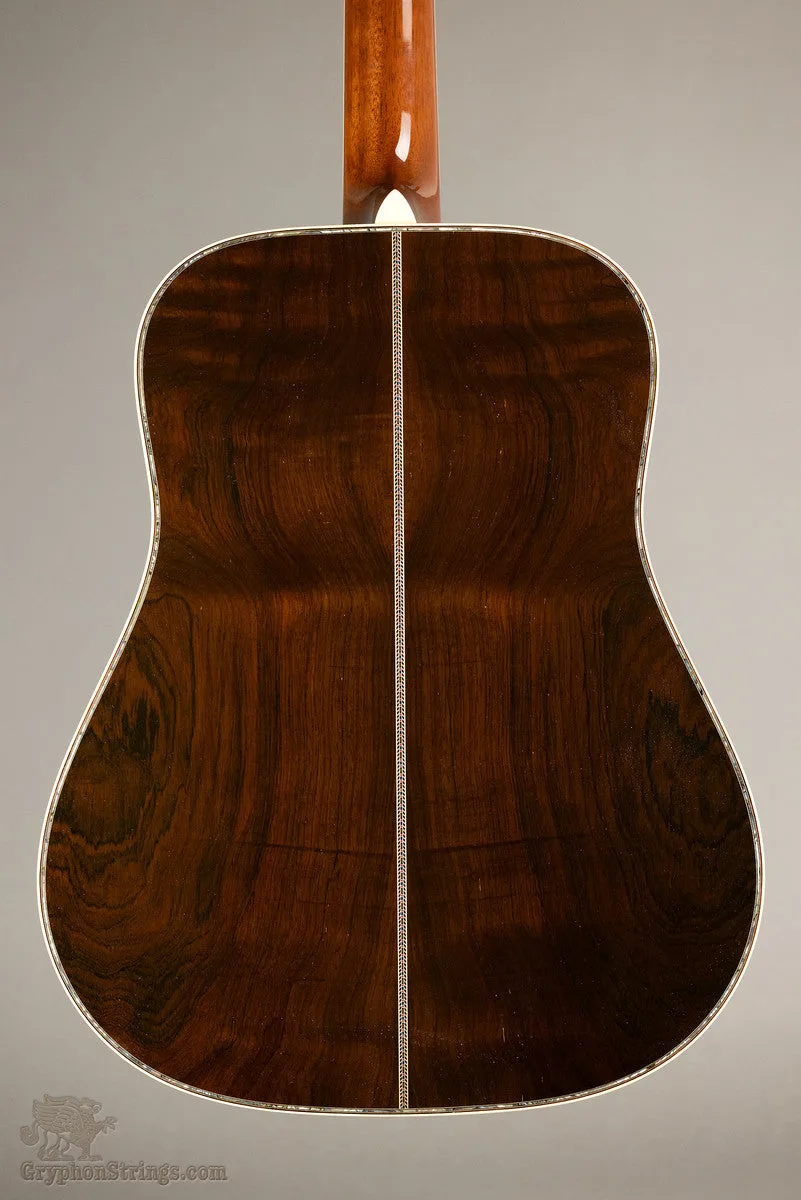
We are very excited to announce the arrival of our Martin’s D-45 Project 91 guitar, which is a limited run of exact replicas of each of the 91 examples of the Model D-45 made before 1942. We got #3, which is based on the first 14-fret D-45. (The first and second D-45s were 12-frets.) The original version of our example, D-45S serial #63715, entered production June 29, 1936, and was sent to Hunleth Music in St. Louis when completed. Of course nobody knows for sure, but since the first two 14-fret D-45 models were made with a slightly wider Dreadnought body, one has to wonder if Martin’s original plan was to make their top Dreadnought model in this slightly larger size. This example is made of truly spectacular Brazilian Rosewood with an Adirondack spruce top and it sounds like a million bucks.

The Rest of the Story>


New Store Hours Starting July 7

Dear Friends,

Gryphon will be closed Saturday, July 4, for Independence Day, as well as Sunday, July 5, and Monday, July 6.

When we reopen on Tuesday, July 7 we will be changing our store hours and Gryphon will no longer be open on Mondays, instead we will be open Tuesday through Saturday from 10:30 until 6.

By closing on Sundays and Mondays, we can have nearly our entire team available during business hours, allowing us to provide more efficient trade-in evaluations, repair consultations, and access to our specialized expertise when you visit.

Thank you for your understanding and continued support. We look forward to seeing you soon.

The Gryphon Crew

Our Current eBay Auctions

We started our eBay auctions as a way to clear out the collection of instruments needing work, and the parts to fix them, that have accumulated in our attic over the decades. We purchased them all with the intention of fixing them up to sell when the repair shop had some down time. Well, the flow of customer repairs has never slowed and some of these instruments have been up there for decades. It’s time to face the fact that if something has been sitting there for ten or twenty years, we are not likely to ever get around to fixing it. And even with that example, we are still taking in instruments that need work but instead of sitting on them for thirty years, we’re putting them up on eBay right away.

We start new auctions every Thursday so check back regularly. Who knows what treasures will show up?

More Info>